
Key Takeaways
Quick answer: Electricity in New York is generated at power plants, moved through a shared grid, delivered by your local utility, and measured at your home by a meter — which is where your bill comes from. This page walks through each step in plain language, so the system stops feeling invisible.
Electricity Isn’t Stored — It’s Made the Moment You Use It
Here’s something most people never stop to think about: the electricity lighting your room right now was generated seconds ago. It isn’t sitting in a tank somewhere waiting for you. Unlike water in a reservoir or gas in a tank, electricity mostly can’t be stockpiled at large scale. It has to be produced in real time, the instant it’s needed, and used almost immediately.
Electricity Is Energy in Motion
Energy is simply the capacity to do work — it powers movement, heat, and light, and it changes from one form to another. Electricity is one of those forms: energy in motion, flowing rather than sitting still.
It’s Flow, Not Storage
Because electricity is generated and used in near real time, the whole system is built to keep supply and demand balanced minute by minute. That single fact — flow, not storage — explains a lot about how the rest of the system works.
Where Your Electricity Actually Begins
Somewhere, right now, a turbine is spinning. It might be inside a natural gas plant an hour from your house, or deep in a dam holding back a river, or standing tall in a wind field you’ve driven past without noticing. None of that shows up when you flip a switch. The light just comes on. But every bit of electricity in your home started as motion somewhere else, turned into a form that can travel.
What “Generation” Actually Means
Most large-scale electricity comes down to one basic act: spinning a turbine, which spins a generator, which turns motion into electricity. The fuel or force that does the spinning is what changes — the spinning itself is the constant.
Heat Creates Motion, Motion Creates Electricity
Many plants work by making heat: heat boils water into steam, steam spins the turbine, the turbine drives the generator. Whether the heat comes from burning fuel or from a nuclear reaction, the spinning principle is the same.
Generation Happens Far From Where It’s Used
Most power plants sit well outside city centers, near fuel supply, water, or transmission access. That distance is exactly why the next step — moving the electricity — matters so much.
Different Sources, Same System
Picture a few very different buildings. One burns fuel to boil water into steam. One splits atoms to make heat. One has no fuel at all — just blades catching wind. They look nothing alike, and yet most of them end up doing the same thing: spinning a turbine to produce electricity.
Fossil Fuels Burn Something to Make Heat
Natural gas plants, and a shrinking number of oil and coal plants, burn fuel to create heat, which creates steam, which spins the turbine. Burning fuel is also what produces emissions — a thread this page picks up briefly further down.
Nuclear Makes Heat Without Burning
Nuclear plants make heat by splitting atoms rather than burning fuel. There’s no combustion involved, and yet the back half of the process is familiar: heat, steam, turbine, generator.
Renewables Skip the Burning Step
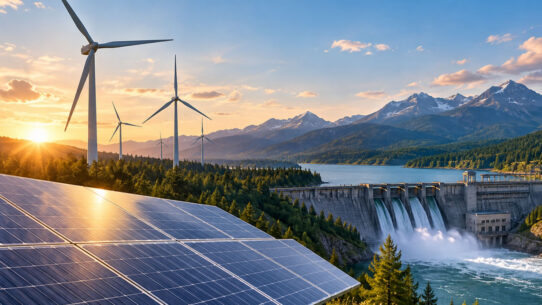
Wind spins blades directly. Hydro uses falling water. Solar is the exception to the whole turbine story — it converts sunlight straight into electricity, with no spinning part at all. Different mechanisms, feeding the same system.
New York Runs on a Mix, Not a Single Plant
The electricity on the grid at any moment is a blend of all these sources at once — gas, hydro, nuclear, wind, solar — each contributing a different share. That blend shifts constantly.
You Consume a System, Not a Plant
The electricity in your home doesn’t come from one specific plant you could point to. It comes from whatever’s flowing into the shared grid at that moment — a mix of many sources feeding one network.
The Mix Shifts by the Hour
On a windy day, wind supplies more. On a still, hot afternoon, gas plants often carry more of the load. The state’s electricity mix isn’t fixed — it moves throughout the day based on weather, demand, and availability.
Real Places Behind the Mix
Every share of that mix traces back to actual facilities across New York — gas plants, dams, wind and solar sites, nuclear stations, and more. Our energy profiles map these real locations across the state, so the “mix” stops being an abstraction and becomes a set of places you can actually look up.
Pollution Happens at Generation, Not at Your Outlet
Here’s a connection that’s easy to miss: when a plant burns fuel to make electricity, that same burning also releases emissions into the air. It happens at the plant — not at the wall socket in your living room.
Burning Fuel Releases More Than Heat
Combustion-based generation gives off byproducts along with the electricity — pollutants often referred to by names like PM2.5, NOx, and ozone. Sources that don’t burn fuel, like wind, solar, hydro, and nuclear, don’t release this particular category of emissions.
The Outlet Is Clean — the Source Is Where It Happens
The electricity arriving at your outlet looks identical no matter how it was made. The difference is entirely upstream, at the point of generation. That’s why understanding the source matters.
How Electricity Finds Its Way to You
Once electricity is made, it has to travel — sometimes hundreds of miles — before it ever reaches a wall outlet. It moves through a series of layers, each one handing it off to the next, until it finally reaches your neighborhood.
Transmission Moves Power Long Distances
High-voltage transmission lines — the tall towers you see running along highways — carry large amounts of power over long distances without losing too much along the way.
Substations Step the Voltage Down
Before electricity can safely enter neighborhoods, substations adjust it, lowering the very high transmission voltage in stages until it’s manageable for local delivery.
Distribution Handles the Last Stretch
From there, local distribution lines carry electricity the final stretch into homes and businesses — the wires and poles you actually see on your street.
Why Outages Happen
Because the grid is shared and interconnected, weather, heavy demand, or equipment failure in one part can ripple outward and affect service elsewhere. A high-level operator called the NYISO helps keep the statewide system balanced in real time.
Your Utility’s Role in the Journey
Here’s a mix-up that trips a lot of people up: your utility company almost certainly didn’t generate your electricity. In most of New York, utilities don’t own the power plants at all. Their job starts after generation — delivering what’s already on the grid safely to your door, maintaining the wires, and responding when something goes wrong.
Generation and Delivery Are Usually Separate Businesses
In New York’s system, power generation companies and utility delivery companies are typically different entities entirely. Your utility bill often reflects both — but they’re not the same operation.
The Utility Owns the “Last Mile”
Utilities are responsible for the local wires, poles, and transformers that carry electricity the final stretch into homes and businesses. That’s the piece they build, maintain, and repair.
This Split Is Why Bills Can Look Layered
Because generation and delivery are separate, your bill can include separate charges for each. That’s not an error or an upcharge — it reflects two different parts of the system doing two different jobs.
The Meter: How Electricity Gets Measured
At some point, all of this — generation, the grid, delivery — narrows down to one small device on the side of your house: the meter. It’s easy to walk past it a thousand times and never think about what it’s doing. But that meter is the only place where the entire system becomes a number.
The Meter Measures Usage, Not Cost
A meter tracks how much electricity — measured in kilowatt-hours — passes through it over time. It doesn’t set the price; it just counts the flow.
A Kilowatt-Hour Is a Unit of Work Done
One kilowatt-hour is the energy used by a 1,000-watt appliance running for one hour. It’s the basic unit your entire bill is built on.
Usage Follows the Seasons
Electricity use tends to rise and fall with the weather — heating in winter, cooling in summer — along with everyday appliances and daily habits. That seasonal pattern is a big part of why bills move around.
Reading Your Bill Without the Confusion
The bill is where everything on this page finally becomes personal. Generation, the grid, the utility, the meter — it all lands, once a month, as a single piece of mail or an email notification. For most people, it’s the only part of the entire system they ever actually look at.
Two Main Charges Make Up Most Bills
Bills typically separate a supply charge (the cost of the electricity itself) from a delivery charge (the cost of getting it to you). Depending on your setup, you might buy your supply from your utility or from a separate company called an ESCO — an independent energy supplier — which can show up as its own line.
Usage Drives the Number More Than Price Alone
Bills change month to month largely because usage changes — more heating, more cooling, more devices running. Price matters too, and usage is often the bigger swing factor.
Bills Show Cost, Not Consequence
Every number on a bill traces back to something measurable: kilowatt-hours used, rate per kilowatt-hour, delivery charges, and any fees. One thing a bill doesn’t show is where the electricity came from or what it took to make — which is part of why the source stays invisible.
Bringing It All Together
Step back for a second and look at the whole shape of it: a turbine spins somewhere in the state, that electricity joins a shared grid, your utility carries it the last mile, a meter counts what you use, and a bill turns that count into a number you recognize. None of it is random. It’s a system — connected, measurable, and understandable once you can see the whole shape.
This Foundation Supports Everything Else
Once generation, the grid, delivery, and billing make sense, two bigger questions become much easier to explore: what electricity generation means for the air we breathe, and what it means for a household’s personal carbon footprint.
Nothing Here Requires a Decision From You
Understanding how the system works doesn’t come with an action attached. It’s simply the ground floor — the part that makes every later conversation about energy easier to follow.
Frequently Asked Questions
How is electricity actually generated in New York?
Through a mix of sources — natural gas, hydroelectric dams, nuclear power, and a growing share of wind and solar — most of them spinning a turbine, with solar as the exception that converts sunlight directly.
Why can’t electricity just be stored for later?
At large scale, it mostly can’t be — electricity is generated and used in near real time, which is why the system is built to balance supply and demand minute by minute.
What’s the difference between a power plant and a utility company?
A power plant generates electricity. A utility company typically delivers it to homes and businesses. In New York, these are usually separate companies.
How does electricity get from a power plant to my house?
It travels through high-voltage transmission lines, gets stepped down at substations, then moves through local distribution lines into your home.
Does pollution come from my outlet?
No — any emissions happen at the point of generation, where fuel is burned, not at your outlet. The electricity arriving at your home looks the same regardless of how it was made.
What does my electric meter actually measure?
It measures how many kilowatt-hours of electricity pass through it — the basic unit of usage your bill is built on.
Why does my electric bill go up and down each month?
Mostly usage — how much heating, cooling, and appliance use happened that month — combined with the rate charged per kilowatt-hour.
Is my utility the same company that generates my electricity?
Usually not. Most New York utilities deliver electricity generated by separate power companies, which is why some bills show separate supply and delivery charges. Why does this page avoid talking about “clean” vs. “dirty” energy?
Because this page is about how the system works, not about judging any part of it.

Author: Frank Rosa
After decades in energy and sustainability, Frank founded Clean Energy Local to make electricity easier to understand—connecting how power is made with the grid, air quality, health, and everyday carbon footprint.